
Potential advantages
Expandable capacity; efficient storage when empty; generous display panels; can support multiple closure styles.
A flexible bag with inward-folded side panels that expand when filled to provide greater capacity. Side-gusset packs use folds on both sides that open outward as the product is filled. Depending on the application, the top and bottom may be sealed, stitched, folded or fitted with a closure. Coffee bags are a familiar example, but the term covers multiple constructions.
A side-gusset bag expands through folded panels on its sides rather than relying only on a bottom gusset.
Look at the side profile as well as the front: folds change the printable area and how the filled pack sits. This is a conceptual visual, not a production sample or approved dieline.
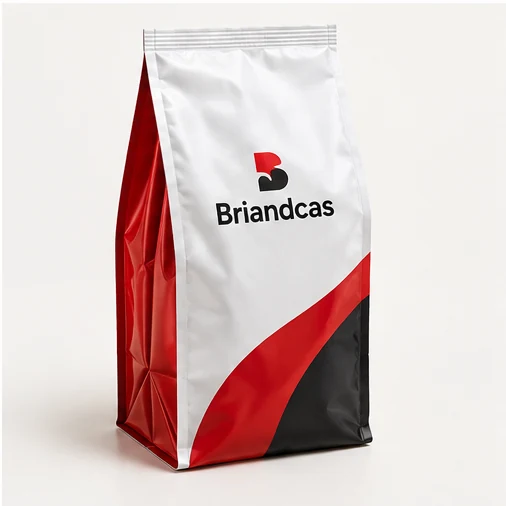
Schematic only; not to scale. Final material construction, dimensions, seals, closures and print zones must come from the selected packaging converter.
Side-gusset packs use folds on both sides that open outward as the product is filled. Depending on the application, the top and bottom may be sealed, stitched, folded or fitted with a closure. Coffee bags are a familiar example, but the term covers multiple constructions.
Common component roles are described below for learning. They are not a recommended bill of materials for every product or supplier.
| Component / layer | Typical role and specification questions |
|---|---|
| Outer print surface | Paper or film-based outer web selected for print and handling. |
| Barrier structure | May include foil, metallised film or polymer layers depending on aroma, oxygen and moisture requirements. |
| Inner sealant / liner | Provides product-contact surface and sealing capability where the design uses heat seals. |
Coffee, dry ingredients, pet food, grains, powders and other products where a gusseted capacity and a familiar bag shape are useful.
Expandable capacity; efficient storage when empty; generous display panels; can support multiple closure styles.
May not stand reliably unless the bottom is designed for it; folds can hide graphics; valve or closure placement adds constraints.
Define the product’s sensitivity to moisture, oxygen, light, aroma, contamination, impact or leakage where relevant.
Confirm filling equipment, speed, sealing method, machine compatibility, pack orientation and expected production volume.
Consider transport, stacking, shelf presentation, opening, carrying, reclosure and local end-of-life realities.
Treat gussets as separate panels and check how they appear when the bag is filled. Important copy should not straddle folds unless the converter confirms registration and visibility.
No. The bottom construction varies by bag type.
For suitable products, it can allow gas to escape while limiting air ingress; selection and performance must be confirmed with the supplier.
Often yes, but usable area and alignment depend on the construction and converting equipment.
This guide is educational and is not a substitute for packaging engineering, product testing, food-contact review or current regulatory advice. Confirm applicable Kenyan and destination-market requirements with the responsible product owner and qualified specialists.
Share the product, target pack size, filling method, reference images and converter specification. Briandcas can help scope the design and prepress requirements.