
Potential advantages
Efficient high-speed packing; good for individually wrapped products; repeatable pack dimensions; strong branding across the web.
A continuous web is formed around a product and sealed into a pack with a characteristic pillow-like shape. Flow wrapping commonly forms a film tube around a product, then closes a longitudinal fin or lap seal and transverse end seals. The pack shape follows the product and the machine setup. “Pillow pack” is a common description of the finished appearance, not a guarantee of one exact seal layout.
Flow-wrap packaging forms a flexible pillow-shaped pack with a longitudinal seam and end seals.
The mock-up helps identify the pack silhouette; the technical section explains the seam and end-seal zones that affect artwork. This is a conceptual visual, not a production sample or approved dieline.
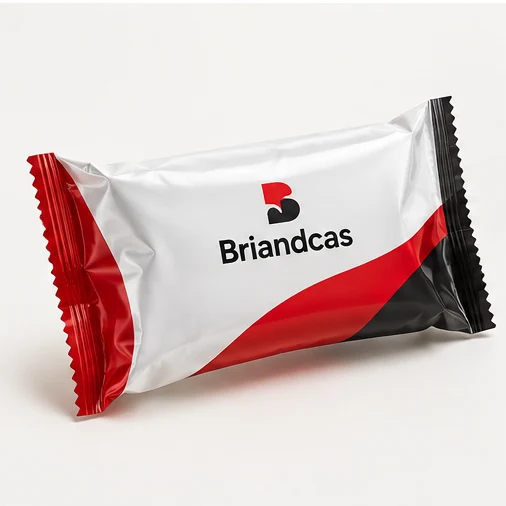
Schematic only; not to scale. Final material construction, dimensions, seals, closures and print zones must come from the selected packaging converter.
Flow wrapping commonly forms a film tube around a product, then closes a longitudinal fin or lap seal and transverse end seals. The pack shape follows the product and the machine setup. “Pillow pack” is a common description of the finished appearance, not a guarantee of one exact seal layout.
Common component roles are described below for learning. They are not a recommended bill of materials for every product or supplier.
| Component / layer | Typical role and specification questions |
|---|---|
| Printable outer web | Provides the graphics and the surface properties needed for handling and printing. |
| Optional barrier or support layer | Selected for product requirements and machine performance. |
| Sealant surface | Allows the film to form longitudinal and end seals under the process conditions. |
Biscuits, confectionery, bars, bakery products, soap, stationery, multipacks and individual items wrapped at speed.
Efficient high-speed packing; good for individually wrapped products; repeatable pack dimensions; strong branding across the web.
Graphics can rotate around the product; end seals consume space; film tracking and registration affect print alignment; not normally reclosable.
Define the product’s sensitivity to moisture, oxygen, light, aroma, contamination, impact or leakage where relevant.
Confirm filling equipment, speed, sealing method, machine compatibility, pack orientation and expected production volume.
Consider transport, stacking, shelf presentation, opening, carrying, reclosure and local end-of-life realities.
Design around the actual wrap path, fin-seal position, end-seal allowances and cut pitch. Confirm whether the print is viewed upright on the shelf or when the pack is held.
The terms overlap in everyday use, but flow wrap usually refers to the wrapping process and pillow pack to a common resulting shape.
Film tracking, registration, pack rotation and the relationship between cut and seal zones all affect alignment.
Yes, when the complete structure, inks/adhesives where relevant, sealing process and food-contact compliance are suitable for the intended use.
This guide is educational and is not a substitute for packaging engineering, product testing, food-contact review or current regulatory advice. Confirm applicable Kenyan and destination-market requirements with the responsible product owner and qualified specialists.
Share the product, target pack size, filling method, reference images and converter specification. Briandcas can help scope the design and prepress requirements.